r audit

Published

March 18, 2026

The Audit

Timed, two hours. Reference only. Honest self evaluation of skill using STRONG / SHAKY / GAP

Task Rating
Load a CSV and inspect its structure using tidyverse Strong
Write a dplyr pipeline: filter, select, mutate, groupby, summarize Shaky
Produce a ggplot2 bar chart with correct labels Shaky
Run a linear regression, call summary(), and explain each component of the output in writing Gap
Render a Quarto document with inline R output to HTML Strong

Load a CSV and inspect its structure using tidyverse

Start time: 14:00

Code
library('tidyverse')
── Attaching core tidyverse packages ──────────────────────── tidyverse 2.0.0 ──
✔ dplyr     1.2.0     ✔ readr     2.2.0
✔ forcats   1.0.1     ✔ stringr   1.6.0
✔ ggplot2   4.0.2     ✔ tibble    3.3.1
✔ lubridate 1.9.5     ✔ tidyr     1.3.2
✔ purrr     1.2.1     
── Conflicts ────────────────────────────────────────── tidyverse_conflicts() ──
✖ purrr::%||%()   masks base::%||%()
✖ dplyr::filter() masks stats::filter()
✖ dplyr::lag()    masks stats::lag()
ℹ Use the conflicted package (<http://conflicted.r-lib.org/>) to force all conflicts to become errors
Code
library('here')
here() starts at /home/teacher/projects/edu-analytics/learning
Code
library('fs')
Code
data_dir <- here('data')
data_files_names <- c('school_quality.csv', 'hs_directory.csv', 'school_demographics.csv')
# construct a relative to the project root
Code
# data_files <- paste(data_dir, data_files_names, sep = '/')
# or
data_files <- tibble(path=fs::path(data_dir, data_files_names),file=data_files_names)
Code
school_quality_path <- data_files[1]

Stop trying to load three tables

Code
school_quality_tib <- read_csv(here('data/raw/school_quality.csv'))
Rows: 1000 Columns: 12
── Column specification ────────────────────────────────────────────────────────
Delimiter: ","
chr (6): dbn, school_name, report_type, school_type, metric_variable_name, m...
dbl (5): school_year, report_year, number_of_students, metric_value, compari...
lgl (1): metric_score

ℹ Use `spec()` to retrieve the full column specification for this data.
ℹ Specify the column types or set `show_col_types = FALSE` to quiet this message.
Code
# could specify column types but won't for the audit
school_quality_tib
# A tibble: 1,000 × 12
   school_year report_year dbn    school_name            report_type school_type
         <dbl>       <dbl> <chr>  <chr>                  <chr>       <chr>      
 1        2020        2021 01M015 P.S. 015 Roberto Clem… EMS         Elementary 
 2        2020        2021 01M015 P.S. 015 Roberto Clem… EMS         Elementary 
 3        2020        2021 01M015 P.S. 015 Roberto Clem… EMS         Elementary 
 4        2020        2021 01M015 P.S. 015 Roberto Clem… EMS         Elementary 
 5        2020        2021 01M015 P.S. 015 Roberto Clem… EMS         Elementary 
 6        2020        2021 01M015 P.S. 015 Roberto Clem… EMS         Elementary 
 7        2020        2021 01M015 P.S. 015 Roberto Clem… EMS         Elementary 
 8        2020        2021 01M015 P.S. 015 Roberto Clem… EMS         Elementary 
 9        2020        2021 01M015 P.S. 015 Roberto Clem… EMS         Elementary 
10        2020        2021 01M015 P.S. 015 Roberto Clem… EMS         Elementary 
# ℹ 990 more rows
# ℹ 6 more variables: metric_variable_name <chr>, metric_display_name <chr>,
#   number_of_students <dbl>, metric_value <dbl>,
#   comparison_group_average <dbl>, metric_score <lgl>
Code
names(school_quality_tib)
 [1] "school_year"              "report_year"             
 [3] "dbn"                      "school_name"             
 [5] "report_type"              "school_type"             
 [7] "metric_variable_name"     "metric_display_name"     
 [9] "number_of_students"       "metric_value"            
[11] "comparison_group_average" "metric_score"            

There are 12 (should be 12) columns.

Report grain is a school quality metrics values per school per year. Table is already long with metric_variable column containing metric scoring categories. Further analysis requires choosing pertinent subgroups.

Write a dplyr pipeline: filter, select, mutate, groupby, summarize

Start time: 14:30

The following school quality metric variables are available:

Code
variables <- data.frame(unique(school_quality_tib$metric_variable_name))
years <- data.frame(unique(school_quality_tib$report_year))

There are 212 (should be 212) variables. Let’s focus on chronic absenteeism. Metrics are probably unique by year, so we’ll also look at the most recent year.

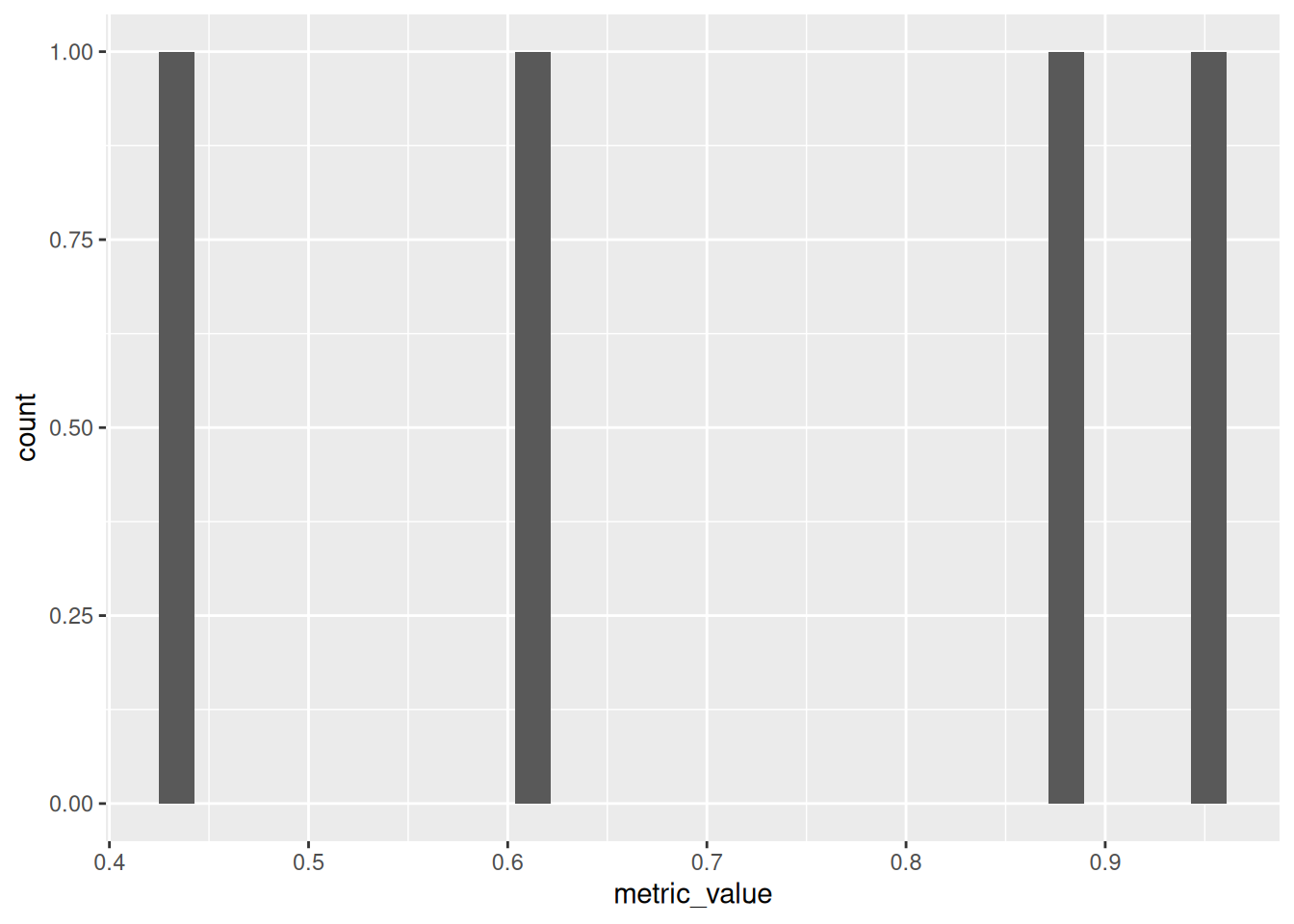
High school chronic absenteesim as a tbl_df.

Code
hs_chronic_absent_2021 <- school_quality_tib %>%
  filter( school_quality_tib$metric_variable_name=='chronic_absent_hs_all') 
    
hs_chronic_absent_2021  %>%
      select(metric_value)
# A tibble: 4 × 1
  metric_value
         <dbl>
1        0.434
2        0.618
3        0.952
4        0.877

Took a long sojourn into the school quality educator guide to find the key to the race coding, such as chronic_absent_hs_allea 40 chronic_absent_hs_alleb 41 chronic_absent_hs_alleh 42 chronic_absent_hs_allei 43 chronic_absent_hs_allem

Also I can’t find the chronic absent metric for special education. Moving on.

Let’s try a regular expression on the chronic_absent_hs and drop the year filter. By the way there is no real data for report years 2020 and 2021. I think it is carry over data, but haven’t investigated.

We’ll select rows matching a regular expression and group by year.

Code
hs_chronic_absent_grouped <- filter(school_quality_tib,
  school_quality_tib$metric_variable_name=='chronic_absent_hs')

(years shows a year 2025, but for some reason filtering on 2025 returns an empty tibble.)

Code
school_quality_tib %>% filter(
  str_detect(string = school_quality_tib$metric_variable_name, 
            pattern = 'chronic_absent_hs_all[a-z]+'
            ),
  ) %>% 
    select(c(report_year, metric_value, dbn)) %>%
      group_by(report_year) %>%
        summarize(avg = mean(metric_value))
# A tibble: 1 × 2
  report_year   avg
        <dbl> <dbl>
1        2021    NA

Produce a ggplot2 bar chart with correct labels

Start time: 15:45

Code
data <- school_quality_tib %>%
          filter(metric_variable_name=='chronic_absent_hs_all') %>%
            select(metric_value)

data %>% ggplot(mapping = aes(x=metric_value)) +
           geom_histogram()
`stat_bin()` using `bins = 30`. Pick better value `binwidth`.

Create a linear regression, call summary(), and explain each component of the output in writing

Ran out of time for this. I could call lm() and summary()

Render a Quarto document with inline R output to HTML

This document and the whole learning site build without errors. ## Reflection The biggest take away after completing the audit is that I can figure out a lot, but have to make many decisions and then relarn as I working. There isn’t one this is how I do this that I’m comfortable with. Even within one library. # Experiments

Import School Data

HS Directory

Program parsing

Each row of the hs_directory dataset is a school. Schools house one or more programs, which independently enroll students. Programs offer a number of seats available to general education and special education students and may also audition students. Programs can screen for grades and have priorities for enrolling from geographic areas and underrepresented minorities.

We want both one row per school and one row per program data. To get one row per program we
Code
column_schema_helper <- function() {
  cols <- names(hs_directory)
  cols_len <- cols %>%
    tibble() %>%
    mutate(
      n_chars = nchar(cols)
    ) %>%
    arrange(desc(n_chars))
  cols_len
}
Code
column_schema <- column_schema_helper()
print(column_schema)
Code
list_matches <- function(regx) {
  regx_list <- list(
    '^grade9swdapplicatsperseat\\d+$',
    'grade9geapplicantsperseat\\d+'
  )
  cols = names(hs_directory)
  cols %>% grep(regx)

}
Code
local({
  # cols %>% grep("^grade9geapplicantsperseat\\d+$", ., value=TRUE)
  # cols %>% grep("^seats9ge\\d$", ., value=TRUE)
  # cols %>% grep("^requirement_\\d_\\d+$", ., value=TRUE)
  cols %>% grep("^program\\d+$", ., value=TRUE)
})
Code
classify_families <- function() {
  cols_tbl = tibble(col = names(hs_directory)) %>%
    mutate(
      family= case_when(
        str_detect(col, "grade9geapplicantsperseat\\d+$") ~ "grade9geapplicantsperseat",
        str_detect(col, "^seats9ge\\d$")                  ~ "seats9ge",
        str_detect(col, "^requirement_\\d_\\d+$")        ~ "requirement",
        str_detect(col, "^program\\d+$")                 ~ "program",
        str_detect(col, "^grade9swdapplicatsperseat\\d+$") ~ "grade9swdapplicatsperseat",
        str(col, "^grade9swdseatsperseat\\d+$") ~ "grade9swdseatsperseat",
        str_detect(col, "^grade9swdpriority\\d+$") ~ "grade9swdpriority",
        str_detect(col, "^grade9gepriority\\d+$") ~ "grade9gepriority",
        
        TRUE ~ "other"
      )
    )
    cols_tbl %>% count(family, sort=TRUE)
}